

A comprehensive analysis of smart glass and privacy film performance after dark, and the most effective solutions to maintain your privacy.
Yes, people can often see through smart glass or privacy film at night, but it depends on lighting. When the inside of a space is lit and the outside is dark, both (even in privacy mode) can lose much of its privacy because silhouettes and shapes become visible. During the day it works much better because the brighter exterior overwhelms lighter interior.
For true night privacy, smart glass and film alone is not enough. You usually need blinds, curtains, or a secondary film solution. Smart glass and smart film work by scattering light rather than blocking it. This is an important distinction for understanding privacy at night.
Smart glass and smart film, also known as switchable glass, control how much light passes through by changing their optical properties when voltage is applied or removed. The most common type uses PDLC (Polymer Dispersed Liquid Crystal) technology, which switches between a transparent state that is clear like normal glass and an opaque or frosted state that scatters light to provide privacy.
The effect can seem impressive, but the underlying principle is straightforward light scattering. Smart glass does not block visibility in all conditions. It simply changes the way light passes through the material, and this distinction becomes particularly important after dark.
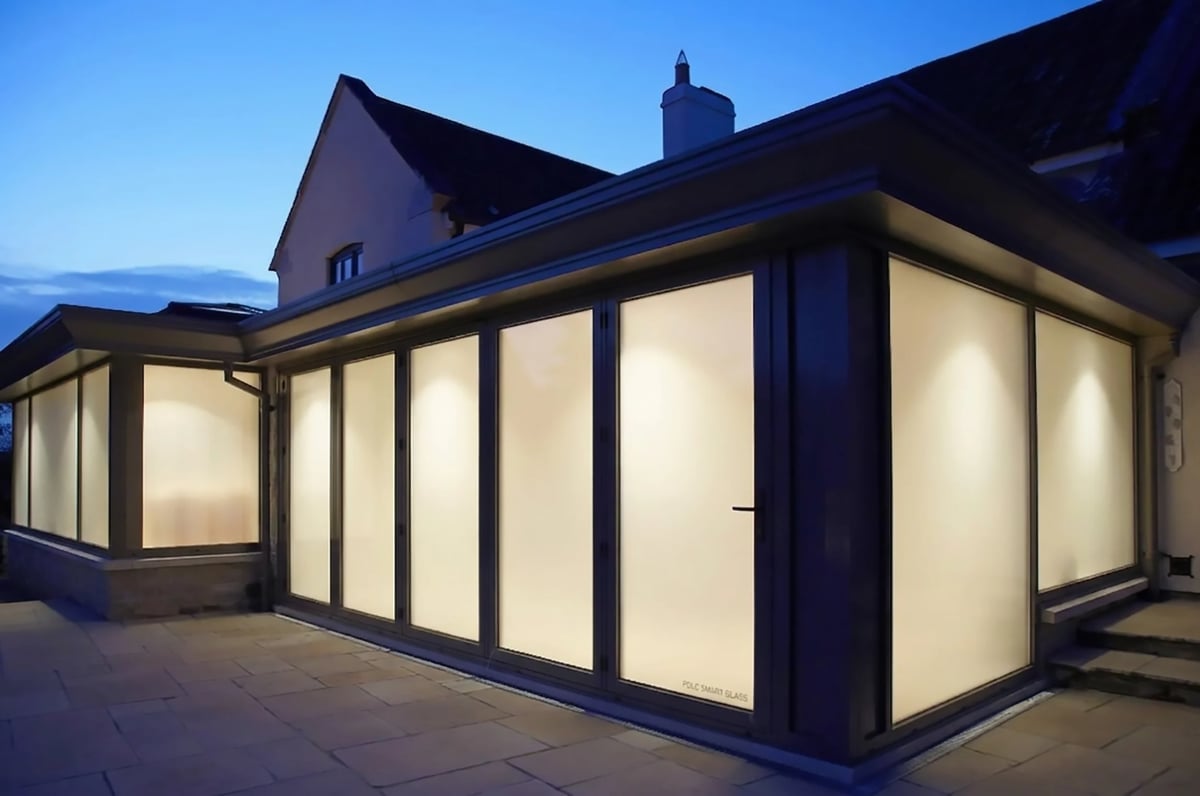
See how smart glass behaves after dark and learn what affects night-time privacy in real-world conditions.
Privacy through any glass surface depends on contrast. The ratio of light on each side of the glass determines what is visible and what remains concealed.
This is where the limitations become apparent. Even when smart glass or smart film is in privacy mode, strong interior lighting can still produce silhouettes and faint outlines that are visible from the outside. The privacy effect is not absolute. It depends heavily on the lighting balance.
Short answer: often yes, at least partially.
Smart glass and smart film act as light diffusers rather than opaque barriers. They reduce visual clarity but do not provide a complete guarantee of privacy. For a more detailed comparison, read about how smart glass and smart film differ in real world conditions.
Let's break down how smart glass behaves in real situations.
This represents the most challenging scenario for privacy. When a room is brightly lit at night and the outside is dark, the contrast between interior and exterior is at its highest. Even with the glass in opaque mode, the PDLC layer can only scatter light to a certain degree. Strong overhead or ambient lighting overpowers this diffusion effect, allowing movement to remain detectable from outside. Shadows cast by people and furniture become visible through the glass, and the general layout of the room can often be inferred by an observer standing nearby.
Even in opaque mode, strong overhead lighting creates enough contrast for silhouettes to appear through the glass. The PDLC layer scatters light but cannot absorb it. This is a fundamental limitation of the technology, not a defect. Learn more about real-world privacy expectations.
Privacy improves considerably under dim interior lighting. When the light level inside is closer to the darkness outside, the contrast driving visibility collapses. The PDLC layer scatters what little light there is more evenly, making shapes significantly harder to detect from outside. The glass takes on a more uniformly frosted appearance, and outside visibility drops to the point where an observer would struggle to distinguish much beyond a soft glow. For rooms where complete privacy after dark matters, reducing interior brightness is one of the simplest and most effective adjustments available.
Exterior light sources such as streetlights, signage, or neighbouring buildings can help to reduce the contrast between inside and outside, which narrows the gap that makes silhouettes visible. This can provide a modest improvement in privacy at night. However, the effect is unreliable. Light from outside rarely falls evenly across a window, and the intensity varies with distance, angle, and obstructions. From certain viewing positions, the interior may still be partially visible, especially if someone inside passes close to the glass. Relying on exterior lighting alone is not a dependable solution for consistent night privacy.
A common misconception is that smart glass behaves like one-way mirror film. The two technologies operate on entirely different principles. One-way mirror film relies on a reflective coating combined with a steep light imbalance. The brighter side sees its own reflection, while the darker side can see through. This effect reverses the moment the lighting balance shifts, which is why reflective films lose their privacy entirely at night when interior lights are on and it is dark outside. Smart glass, by contrast, does not use reflection at all. It scatters light passing through a PDLC layer, creating a frosted appearance rather than a mirrored one. Understanding this distinction is central to setting realistic expectations for night privacy.
At night, the lighting balance reverses and the brighter side becomes the interior of the room. Smart glass cannot override the physics of light. Its PDLC layer alters diffusion by scattering light as it passes through, but it does not create a reflective surface. This means that anyone expecting complete invisibility after dark will be disappointed by the result. Smart glass remains an effective privacy solution during the day, but at night it offers only partial concealment. For an honest assessment of what the technology can and cannot do, read more about the downsides of smart glass.
This comparison clears up a lot of confusion about which solution works best for night privacy.
| Solution | Daytime Privacy | Nighttime Privacy | Best Use Case |
|---|---|---|---|
| Smart Glass | Excellent | Limited | Flexible modern spaces |
| One-Way Reflective Film | Excellent | Fails completely | Daytime-only privacy |
| Frosted Film | Excellent | Excellent | Consistent 24/7 privacy |
| Blackout / Whiteout Film | Maximum | Maximum | Bathrooms, sensitive rooms |
For situations where night privacy is the primary requirement, fixed solutions such as frosted film or blackout film offer a more dependable level of concealment than smart glass on its own. Smart glass excels in flexibility and aesthetic appeal during the day, but its optical limitations after dark mean it cannot be relied upon for complete privacy when interior lights are on. A layered approach, pairing smart glass with a supplementary window treatment for night use, often delivers the best balance of function and discretion. For a detailed side by side breakdown of the different technologies available, see our full comparison guide.
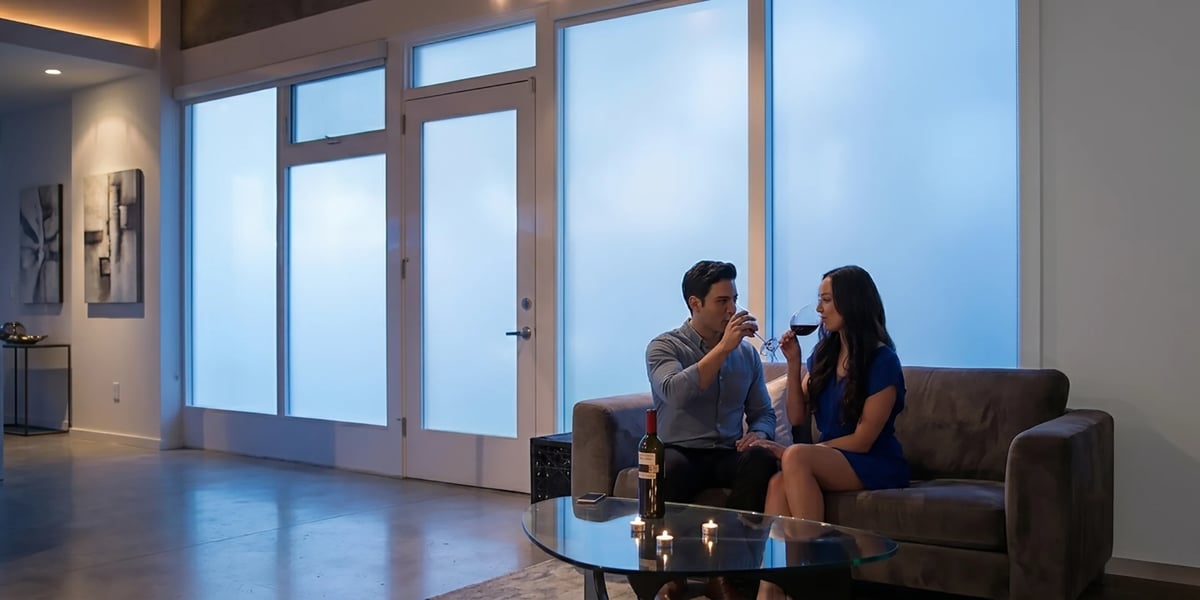
It depends on the space. Here's what works best for different environments and use cases.
Most people combine solutions: smart glass for aesthetics and daytime flexibility, and curtains or blinds for night privacy. This gives you the best of both worlds.
Smart glass works well in meeting rooms during business hours, but is still often paired with blinds for after-hours privacy when interior lights are on and the building is visible from outside.
Smart glass alone is not enough for these sensitive spaces. Frosted or blackout solutions are usually better for reliable night privacy. See our guide on smart glass for bathrooms.
Use softer, diffused light sources and position lamps away from windows rather than relying on bright overhead fittings. Dimmer switches also help you lower light levels quickly when privacy matters.
This is the most reliable solution. Smart glass for daytime flexibility, physical covering for night. You get modern aesthetics without sacrificing privacy after dark.
Rooms that face busy streets or neighbouring buildings need extra planning. Even smart glass performs better when it is not directly exposed to strong external sightlines.
Smart glass should be treated as part of a system, not the only solution. Curtains, blinds, or frosted film still play an important role depending on how private you need the space to be.
Discover whether switchable glass can replace curtains or blinds completely.
If you already have smart glass installed, there are practical ways to improve privacy after dark.
This is the biggest factor. Use softer lighting, avoid bright overhead lights near windows, and use lamps instead of ceiling lights when possible.
This is the most reliable solution. Smart glass for daytime flexibility, physical covering for night. You get the best of both worlds.
Rooms that face busy streets or neighbouring buildings need extra planning. Smart glass performs better when not directly exposed to strong external sightlines.
It depends on your expectations. Here's an honest breakdown.
Most disappointment comes from expecting it to behave like a solid wall. It does not. Learn more about whether privacy glass is worth it.
Yes, often partially.
Smart glass improves privacy, but it does not eliminate visibility when interior lights are on. Nighttime conditions flip the usual privacy effect, and lighting becomes the deciding factor.
If you want reliable privacy after dark, smart glass should be treated as part of a system, not the only solution. Curtains, blinds, or frosted film still play an important role depending on how private you need the space to be.
Selecting a knowledgeable supplier and understanding the real world limits of the technology makes all the difference. Smart glass and privacy film are genuinely useful innovations, but setting accurate expectations about what they can and cannot do, particularly after dark, ensures you achieve a result that matches your requirements.
Not sure how smart glass or smart film will behave in your particular room or building? We can assess your space and recommend the right privacy solution for both daytime and after dark.



Premium smart film and smart glass solutions for Yacht Owners, Architects, Businesses & Home Owners. Transforming your vision into the reality you've dream about.
© 2026 SmartGlassInnovations. All rights reserved.